






The Gig-Driver Fleet Model — Live Workshop
STARTS IN: 00d : 00h : 00m : 00s

FOR ANYONE WHO WANTS INCOME FROM AN ASSET — NOT ANOTHER JOB

The Nicer Your Rental Car, The Less Money It Makes.

I've built a 25-car fleet of the most boring cars you've ever seen — including $3,000–$6,000 Corollas that pay themselves off in about three months and then collect $350–$450 a week — and coached member fleets across the country from zero to fifteen cars. In the Inside a 25-Car Fleet workshop, you're going to discover how to install the Weekly Rent Architecture that makes them pay.

▼ Click Below To Watch First! ▼

0Days
:
0Hrs
:
0Mins
:
0Secs

Recording yours forever. If two hours here doesn't save you from at least one $4,000 mistake — the wrong car, the denied claim, the renter who stops paying and disappears — one sentence gets your $17 back. You keep everything.

LIVE 2-hour online workshop · Attend on Zoom from anywhere · Recording included

The Most Expensive Moment In Car Rental.

You know the story.

A guy buys a $38,000 Charger. Lists it on a rental platform. Does the math out loud:

"This thing will pay for itself."
"Passive income."
"I'll scale to ten of these."

And then… the math arrives.

No steady renters. No margin after the platform's cut. Maybe one good month. Twelve months later the car has depreciated thousands, one renter's damage is still in dispute — and he's re-reading his own listing at midnight, trying to figure out how a car everyone complimented… lost him money.

(Never thought seriously about renting out a car? Stay with me — this same trap is waiting inside the first one you buy.)

"I actually have five, but one has been a lemon ever since I bought it."
— a 5-car operator, on his call with us, before joining

That's not a fluke. That's the mechanism.

He bought the car he'd want to drive. Because the moment he started shopping, his car-lover's brain took over — the same instinct that makes him great at everything else he owns. Buying nice feels safe. It feels smart. It earns compliments.

But a compliment has never paid a week of rent. The renter who NEEDS a car — the Uber driver whose transmission died, the DoorDash driver rebuilding after a repo — doesn't pay for beautiful. He pays $350 to $450 a week for clean, boring, and running. And the nicer the car, the further it gets from the only renter who pays every single week.

Compliments are what it sounds like when a rental car fails.

That's the Beautiful-Car Trap — and it's only the first of five structural failures I find in almost every one-car operation. The other four are further down this page, and most operations have all five.

But here's the part that should actually make you feel better:

It's not your city. It's not your credit. It's not your budget, your mechanical knowledge, or your lack of a dealer license. And it's definitely not you.

It's the architecture. That car was set up like a trophy. A car that pays every week is engineered as something else entirely: a collections machine.

Impressive Cars Get Compliments. Boring Cars Get Rent.

A first car launched on Weekly Rent Architecture doesn't need you to know everything. It needs four pieces installed, in order — each one simple on its own, each one making the next one easy:

There's no moment where you have to become an expert. No day where you out-argue a renter. In a properly installed operation there is no chasing and no guessing — each piece did its job before the situation it exists for ever arrived.

The renter doesn't feel policed. He feels like he signed up for exactly this.

Because he did.

Here's the difference in practice. Research answers questions. An installation retires them — in a very deliberate order. Do you agree a driver who needs the car this week to keep earning treats it better than a weekend stranger? Do you agree paper signed before the keys beats arguments after? Do you agree a wait list is better evidence for buying car two than a good feeling? Each piece is small. Each is obvious on its own. And each one closes, permanently, one of the questions that's kept you researching.

That's why "what if the renter wrecks it, or just stops paying?" isn't really a risk. It's a symptom — the sound of a start attempted in the wrong order. Insurance is a decision made on paper, before any car exists — and once it's made, every question behind it collapses.

That order — which piece first, which paper, which renter, and the exact insurance setup at each stage — is exactly what this workshop walks through.

Zero Cars To Fifteen. Around A Full-Time Job.

Danny came into this with zero cars and a 9-to-5 he still has. Same class of $4,000 cars anyone can buy. Same gig-driver demand that exists in every city. The only thing he added was the architecture — installed in order.

Ten weeks later he had 7 cars. Today he runs 15 — at around $350 a week, each.

Yes, this is real — you'll hear it from him directly below. Not a quit-his-job story. Not family money. Not a cherry-picked market. Zero to fifteen, around a full-time job.

Danny — 0 to 7 cars in 10 weeks, 15 today, ~$350/week each, without quitting his 9-to-5.

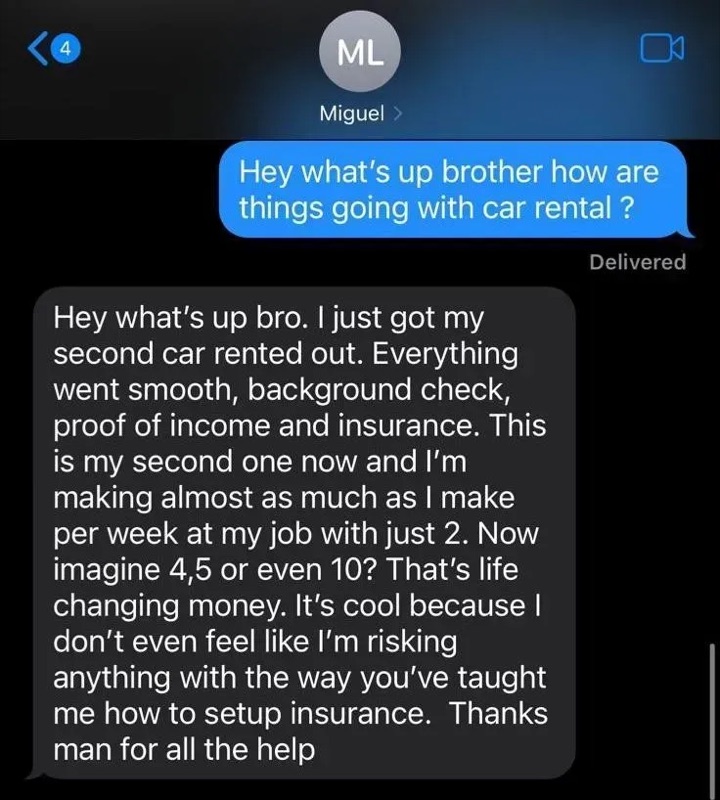
Member text: two cars rented, matching his weekly job income

Miguel — 2 cars in, matching his job's weekly pay.

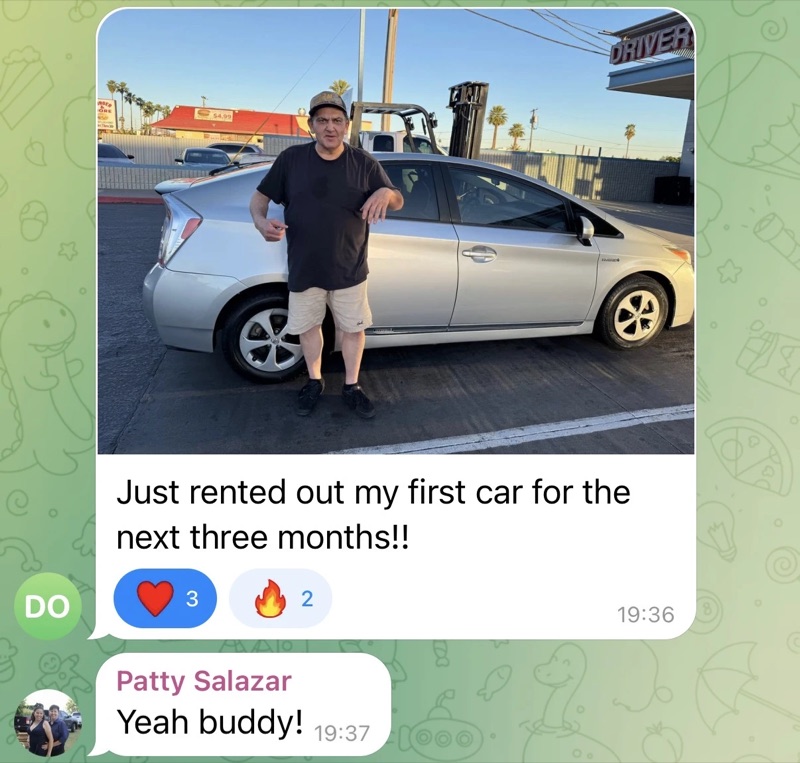
Member's first car rented for three months

First car out — rented for the next 3 months.

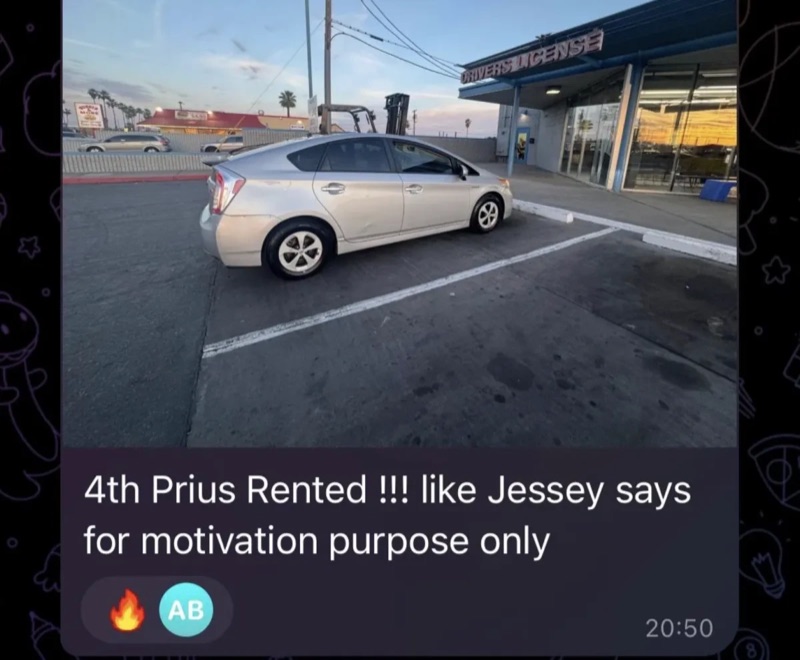
Member's 4th Prius rented

4th Prius rented.

Member payment feed — weekly rents collected

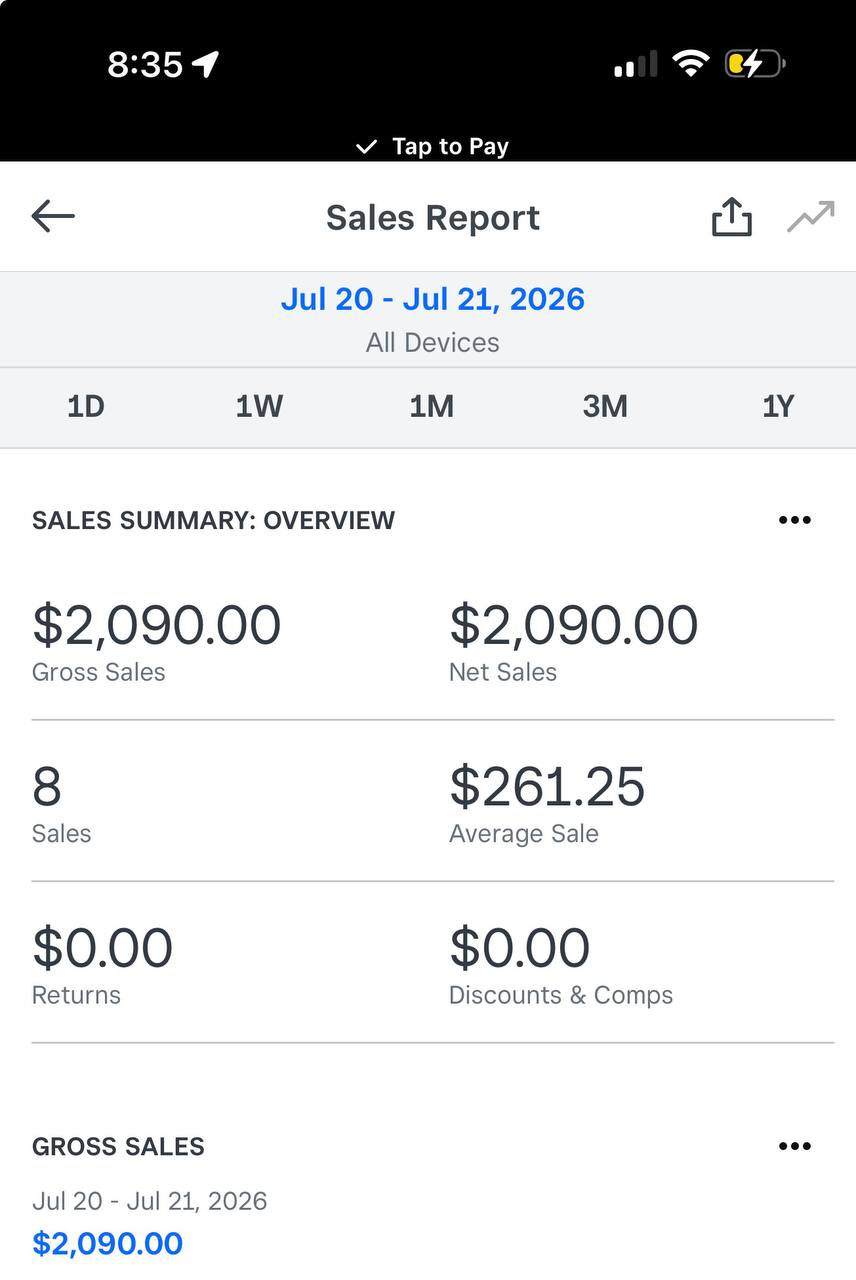
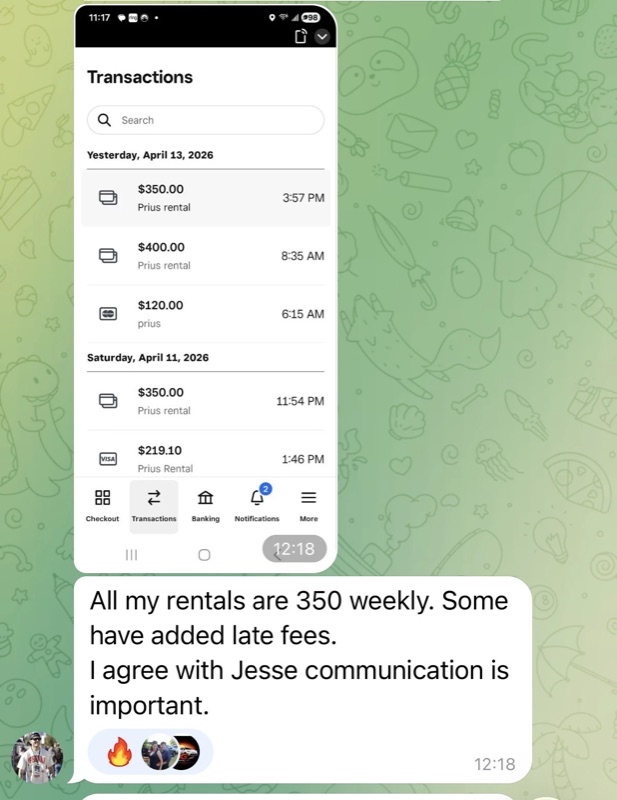
Real weekly rents collected on autopay — "all my rentals are 350 weekly."

And the installation he followed is the same one, in the same order, that I'll walk you through on the workshop.

2-hour live workshop · Attend on Zoom from anywhere · Recording included

Most People Think Car Rental Is A Car Business. I Believe The Opposite.

It's a collections business. The car is just the thing you plug into it.

Sound backwards? Look at who actually gets rich on "boring":

Every business that pays its owner every week is running collections underneath: something that selects the payer, sets the terms, and takes the money on schedule — without the owner performing.

Your money is the diamond. The architecture is the store. Most people park their diamond in a beautiful car — and then blame the diamond.

The 5 Structural Failures I Find In Almost Every One-Car Operation

I've seen inside hundreds of these — Turo hosts, first-car buyers, 3-car side hustles. These are the five failures I can diagnose in the first ten minutes. Most operations have all five. You've already met the first one.

1

The Beautiful-Car Trap

You shop like you're buying for yourself, and the money goes into a car renters want instead of a car renters need. That's not because you're bad with money — it's because you have taste, and taste is exactly the instinct this business punishes. There's a specific set of boring-car criteria that fixes this. Cheap cars aren't the risk. Unverified cheap cars are. A $4,000 car at auction pricing pays itself off in about three months.

2

The Borrowed Storefront

Renting your income from an app: 30 to 40 percent of every booking gone, the algorithm owning your traffic, the rules changing over your head. One operator paid a platform seventy-two thousand dollars in a single year — for renters. The working gig driver who pays every week costs about $10 a day in ads to reach. And he comes to you.

3

The Weekend-Stranger Problem

A new renter every 48 hours is a new risk every 48 hours — and dead weekdays in between. The working driver rents by the month and renews, because the car is how he eats. Same car. Different renter. Completely different business.

4

The Honor-System Rental

Keys handed over on trust: no signed agreement, no autopay, no GPS, no kill switch. One operator called the police five or six times in seven months — four thousand dollars unpaid. His words: "it makes me feel like someone is using me." With the stack installed, a late payment is a Tuesday morning where the car doesn't start. You don't have to be tough. The paperwork is.

5

The Backwards Order

Car first, structure later. Then the discovery: insurers don't cover "one rental car" the way YouTube assumes — and now there's a car in the driveway that can't legally earn. The fix takes days, not months: the structure and the insurance decision made on paper, before any car exists.

One honest question: how many of the five did you just recognize in your own plan?

That recognition is exactly what the workshop turns into a fix.

2-hour live workshop · Attend on Zoom from anywhere · Recording included

About Your Instructors

25 CARSWEEKLY RENT ARCHITECTURE
$40K+/MOCOLLECTED ON AUTOPAY
Jesse Luque

Jesse Luque

The Operator — 25-car fleet, Los Angeles

Pablo Umana

Pablo Umaña

The Systems Builder — the machine behind the fleets

I'm Jesse Luque. I've spent years doing exactly one thing: renting boring cars to working drivers, week after week. No lot, no dealer license, no yacht content — Priuses and Corollas, working renters, weekly autopay.

I run a 25-car fleet on Weekly Rent Architecture — the exact installation this workshop teaches. I've helped members go from zero to their own fleets: Danny from 0 to 15, Alex Ferrer to 14 cars in under a year, and Albert Favors to what he called "two years ahead of schedule."

And between my own cars and the member fleets I work with across the country, I see this business in real numbers every single week — what's renting, what's sitting, what insurance actually costs, what auction prices are doing. Not last year's numbers. This week's. When something changes in this business, I see it in the data before the YouTube gurus have finished filming their reaction to it.

Don't Take My Word For It. Ask The Members:

Danny Ortega

Danny Ortega

0 → 15 CARS

0 → 7 cars in 10 weeks, 15 today, ~$350/week each, without quitting his 9-to-5.

Alex Ferrer

Alex Ferrer

14 CARS IN UNDER A YEAR

14 cars in under a year.

Rick Wave

Rick Wave

FIRST CAR → A REAL BUSINESS

"We're two years ahead of schedule from where we thought we'd be."

"But Everyone Says Car Rental Doesn't Work Anymore…"

They're half right. The playbook everyone watched die — finance something impressive, list it on the app, split with the platform — that model IS dead. Fees climbed to 30–40%. The weekend renter got pickier while payouts got thinner. If you watched someone fail at it, you watched them fail correctly.

The market got sophisticated. The playbook didn't.

One of our members ran cars profitably on a platform — until the payout terms shifted under him. His words: "the fees are what they are, but as far as a program, it's their rules or the highway." He didn't fail. The playbook he was handed did.

Weekly Rent Architecture isn't a fresher coat of paint on that playbook. It's built for the person who already has the antibodies — the one who's seen every pitch and kept his money. Different renter, different terms, a machine you own. Ask yourself: does this page feel like the last guru page you read?

(And that goes for the AI shortcut too — ask a chatbot how to start a car rental business and you'll get a beautiful summary of the dead playbook. The architecture is the part it can't give you.)

And yes — it's still absolutely possible to collect $350–$450 a week per car in 2026. You'll see the receipts on the workshop. It just can't be done with the model your feed already watched fail.

"My Money Is Too Hard-Earned To Gamble On A Guru." Perfect. So Is Mine.

If you've been pitched before — the slideshow course, the rented-Lamborghini guru, the mentor who vanished after the invoice — you've probably read this far thinking: "I've seen this movie."

Good instinct. Keep it.

Hype is what happens when a model can't survive real numbers, so someone sells you a feeling instead. That's why it smells like gambling — with those programs, it is.

This workshop runs on the opposite fuel: boring cars, real weekly rents, the insurance explained the legal way, paperwork that holds. Numbers on screen from a fleet that exists — and you're invited to check every one of them against your own market before you spend a dollar on a car.

Attendees tell us versions of the same thing afterward: they came for the income and stayed because it was the first time someone explained the insurance without dodging.

Numbers are hype-proof. Feelings are what varies.

What's One Boring Car Actually Worth?

Same city. Same budget. Same you. The only thing that changes is the architecture.

How many cars?

5 cars

Monthly$8,667
Yearly$104,000

Gross rent at $400/week — inside the $350–$450 range members actually charge, on cars bought for $3,000–$6,000. And that's before the second effect: at auction pricing, each car pays itself off in about three months — so the fleet funds its own growth. Rent from cars one and two buys car three. That's where the 5-car and 15-car stories come from.

A 1-car operation is proof.
A 5-car operation is a raise.
A 25-car operation is a different life.

Run your own numbers above. Then ask the uncomfortable question: what is the daydream costing you? Every month the idea stays an idea is a month of $1,500–$1,900 per car that never existed.

2-hour live workshop · Attend on Zoom from anywhere · Recording included

Is This Workshop Actually For You?

Be honest. It's built for one of three specific people:

Person 1

You have money parked, and you're done watching it do nothing.

Savings, a CD, an almost-pulled-the-trigger real estate plan. You want an asset that pays monthly — and this one is $3,500, not $300,000, in a machine you can sell tomorrow if you change your mind.

Person 2

You have a 9-to-5 — and zero desire to keep trusting it.

Trades, IT, logistics, healthcare. The paycheck still lands, but something with a date on it — a layoff round, a contract ending, retirement math that doesn't work — told you the job can't be the only engine. You don't want a second job. You want an asset that pays weekly around the one you have: about 4 hours a month per car. And the car never checks your credit score.

Person 3

You've watched the Turo movie.

Tried it yourself, or watched someone try it — the fees, the weekend strangers, the payout changes. You don't need convincing that car rental works. You need the version where you keep what the car earns.

If any of those is you, this is the most important $17 you'll spend this year.

If you're looking for a way to make money with no money at all — no capital, no path to any — this workshop will frustrate you. The model runs on a real asset. Save your $17 and come back when you're ready to own one. (Honesty policy: we'd rather refund you now than disappoint you later.)

Inside The 2 Hours: What You'll Walk Away With

Everything in this workshop is the installation. No crypto tangents, no "mindset" filler.

This isn't a motivation session. It's the operating architecture behind fleets that pay every week — the same one our Accelerator members install with us — taught start to finish in one sitting.

2-hour live workshop · Attend on Zoom from anywhere · Recording included

What People Are Saying After Applying This

Danny — 0 to 7 cars in his first 10 weeks. 15 today — without quitting his 9-to-5.

Alex — 14 cars in under a year.

Albert — "two years ahead of schedule."

Member result

Khalid — first $340 week landing.

Member result

"Almost 1k a day renting these boring cars" — three payments in one day, $875.

Member result

One agreement, 12 weeks of rent booked.

Payment feed — $350–$400 a week per car, on autopay.

Member result

Car #5 out the door — the cars earn BECAUSE they're boring.

And it moves fast: most attendees leave with their car criteria, their insurance plan, and their first-move sequence already written down. This isn't a course you'll "get to." It's two hours you'll use the same week.

Here's Everything You Get For $17

THE INSIDE-A-25-CAR-FLEET WORKSHOP2 hours live, the full installation in order. (The same architecture our Accelerator members pay thousands to install with us — minus the install.)
PERMANENT RECORDING ACCESSthe full replay, yours to keep. Watch the insurance segment twice; most people do.
THE SIMPLE CAR RENTAL PROFITS EBOOKthe written version of the model, in your inbox the moment you grab your seat — so you walk in already speaking the language.
THE $17 GUARANTEEattend the session; if you don't leave knowing exactly what car to buy, what to charge, and how the insurance works, email one sentence and the $17 comes back. You keep the recording and the book.

Your Investment: $17

Secure checkout. Confirmation and Zoom details hit your inbox immediately.

★ Real Talk On Why It's Only $17 ★

We could charge $170 for this session and it would still be the cheapest part of starting this business — one wrong car costs two hundred times this ticket. We're not, and here's the honest math — two reasons, both real.

First: free webinars attract browsers. Seventeen dollars attracts people who intend to do something — and a room full of doers asks better questions, which makes the session better for everyone in it, including you.

Second, the part most pages won't say: some percentage of the people who watch me open the machine will want us to build it with them. That's the Accelerator — our done-with-you program — and it's how this business really makes its money. The $17 doesn't even cover the ads that got you here.

You are not required to want any of that. Come, take the order, take the insurance structure, take all of it, and install it alone. People have. The workshop is complete on its own.

This is the only place the fleet gets opened publicly — the numbers, the paperwork, the dashboard. It doesn't go on YouTube. $17 is the cheapest you'll ever access it.

Quick Answers Before You Grab Your Seat

What if I can't attend live?

Your seat includes the permanent recording — but the live room is where your specific situation gets answered in Q&A.

I've bought car rental courses before. They didn't work. Why would this?

Most of them teach the platform playbook — list the car, wait, pay the fees. This teaches the architecture underneath: which cars, which renters, which paper, in which order. And the guarantee has teeth: if you don't leave with your car, price, and insurance questions answered, one sentence gets your $17 back.

I don't have a car yet. Is this for me?

Yes — that's Person 1 and 2 above. You'll start in the right order instead of un-buying a mistake. If you have no path to any capital at all, save your $17 for now.

I'm on Turo right now. Will this replace it?

That's exactly Person 3. Several members run both during the transition, then move the fleet private as agreements roll over.

My credit is rough. Does that kill this?

No — and you're not alone; it's one of the most common situations in the room. The car is bought with cash at the $3,000–$6,000 level, and the renter carries the driving coverage. Ask about your specific case in Q&A.

Does this work in my city?

The renter base is working gig drivers — anywhere rideshare and delivery apps run, the demand exists. Bring your market to the Q&A.

Is the guarantee really honor-system?

Yes. Attend, and if it didn't deliver, one sentence by email. $17 back, recording stays yours.

What's the catch?

Read the Real Talk section above. Some attendees will later want us to build it with them. Most take the framework and run. Both are fine — that's why it's $17.

Stop Watching Other People Do This. Come Look At One.

The next month will end one of two ways.
The idea stays an idea — or there's a written plan with your car criteria, your price, and your insurance structure on it.

Every month the idea stays an idea, it costs the same $1,500–$1,900 a working car would have collected — the only bill in your life that never shows up as one.

For $17 and two hours, I'll show you the five failures to fix and the architecture that fixes them — the same one running my 25 cars, and the same one our members used to go from zero to fleets.

Worst case? You attend, it doesn't deliver, you email one sentence, the $17 comes back, and you keep the recording and the book — and your saved videos will still be right where you left them.

Your worst case is a $17 refund and a free recording. Your best case is the calculator above.

Permanent recording + the ebook + one-sentence $17 guarantee.


See you at the workshop.
— Jesse Luque —